Best Supply Chain AI Tools in 2026: SCM SENSEI AI and Ask Lora Compared
Supply chain AI tools have moved from experimental to essential. This is a practitioner guide to two of the most capable specialised AI platforms for supply chain management: SCM SENSEI AI and Ask Lora. What they do, how they work, who gets the most value, and what they cost.
Search Google or ask ChatGPT "supply chain influencers" and you will find two names that consistently appear: Lora Cecere, founder of Supply Chain Insights, and Dr. Muddassir Ahmed, founder of SCMDOJO. Both have spent decades serving the global supply chain community, creating research content, building frameworks, and helping practitioners make better decisions. Now both have taken that accumulated expertise and channelled it into AI, making decades of specialised knowledge available on demand to any supply chain professional. The most common question I receive from supply chain leaders and consultants is: "Which AI tools should we actually be using?" This guide gives you an honest, practitioner answer focused on two of the most specialised and capable platforms currently available.
Why Supply Chain AI Tools Matter Now
The supply chain function is sitting on a massive data problem dressed up as an information problem. Most organisations have more supply chain data than ever before: ERP exports, supplier performance data, logistics KPIs, demand signals, procurement spend data, S&OP outputs. The problem is not the data. The problem is that the analytical and decision-making capacity of supply chain teams has not kept pace with the volume and complexity of that data.
Generic large language models like ChatGPT, Claude, and Gemini are useful for general tasks, but they were not built for supply chain decision-making. They lack domain-specific training, structured assessment frameworks, and the ability to benchmark your organisation against real supply chain peer data. They produce generic advice that sounds reasonable but lacks the specificity, quantification, and sequencing that supply chain decisions require.
Specialised supply chain AI tools address this gap directly. They are trained on domain-specific knowledge, built around structured supply chain frameworks, and designed to produce outputs that are directly actionable for procurement managers, supply chain directors, S&OP leaders, and logistics specialists. Two of the most capable purpose-built supply chain AI tools available today are SCM SENSEI AI and Ask Lora.
Both tools are specialised supply chain AI platforms, not generic chatbots applied to supply chain topics. This matters fundamentally. Specialisation means domain-specific training data, structured assessment frameworks, supply chain-specific output formats, and the ability to benchmark and score rather than simply converse. This is the difference between a specialist and a generalist.
SCM SENSEI AI: The Operational Daily OS for Supply Chain
SCM SENSEI AI is an agentic AI supply chain consultant trained exclusively on SCMDOJO's proprietary supply chain knowledge base, frameworks, and courses. It is designed as a daily operating system for supply chain decision-making: a tool that supply chain professionals and consultants use every day to get expert advice, run diagnostic assessments, automate complex workflows, draft documents, and analyse raw data.
What makes SCM SENSEI AI distinctive among supply chain AI tools is its five operating modes, each purpose-built for a different type of supply chain task.
Five Modes: What SCM SENSEI AI Can Do
The Knowledge Foundation
SCM SENSEI AI is trained exclusively on SCMDOJO's proprietary supply chain frameworks and courses. This is not a general-purpose AI model with a supply chain system prompt. It is an AI system built on 15+ years of accumulated supply chain knowledge, practitioner frameworks, and proven methodologies. When you ask SCM SENSEI AI a question about demand planning, S&OP process design, supplier risk management, or procurement strategy, the answer comes from a foundation of domain-specific expertise rather than general internet text.
Agentic Workflows: Where It Goes Beyond Conversation
The Agentic Workflows mode is where SCM SENSEI AI moves from answering questions to executing processes. Rather than giving you advice about how to run an RFP sourcing process, it runs the process for you: generating the questionnaire, managing the workflow steps, processing supplier responses, and producing structured outputs. This is the capability that delivers the 70% time saving on sourcing RFPs and the 3 to 20% operational cost reduction.
SCM SENSEI AI Diagnostics includes 28+ pre-built assessment types covering S&OP, procurement, logistics, inventory, supplier risk, supply chain resilience, lean manufacturing, warehouse operations, and more. You can also simply describe your specific situation in plain language and the AI generates a custom diagnostic: a network disruption scenario, a specific supplier qualification challenge, a lean manufacturing maturity review. If you can describe it, SCM SENSEI can assess it.
- Saves up to 70% of time on complex sourcing tasks including RFP generation and supplier evaluation
- Reduces operational costs by 3 to 20% through workflow automation and process standardisation
- Generates maturity diagnostics in under 2 hours versus 4 to 8 weeks for traditional consulting
- Produces structured supply chain insights from raw ERP data without manual mapping
- Radar charts for supply chain maturity scoring across dimensions
- Risk flags categorised by priority: Critical, High, Medium
- Structured improvement roadmaps: Stabilise, Standardise, Optimise phases
- Portfolio-level analysis and category breakdowns with financial quantification
Ask Lora: The Supply Chain Benchmarking Specialist
Ask Lora is a supply chain AI platform powered by a specialised large language model integrated with 15 years of supply chain research from Lora Cecere, founder of Supply Chain Insights and one of the most respected voices in the supply chain industry. Where SCM SENSEI AI focuses on operational execution and workflow automation, Ask Lora's signature capability is dynamic peer-group benchmarking: comparing your supply chain performance against a database of 571+ companies using visual analytics specifically designed for supply chain strategic assessment.
Ask Lora's Four-Step Assessment Flow
Signature Analytics: What Ask Lora Produces
Ask Lora's visualisation framework is built around three distinctive analytical tools that are specific to supply chain performance assessment:
- Y-Charts:Two-axis performance charts that plot your organisation's metrics against peer group averages to reveal performance gaps across multiple dimensions simultaneously.
- Orbit Charts: Dynamic charts that track operating margin versus inventory turns over time, revealing how your supply chain efficiency trajectory compares to peer companies across multiple reporting periods.
- River of Demand Analysis:A unique visual framework that identifies "organisational rocks" and performance headwinds in your demand signal flow, helping pinpoint structural barriers to S&OP and planning effectiveness.
Ask Lora's peer-group benchmarking is genuinely distinctive. Rather than benchmarking against generic industry averages, it matches your organisation to comparable companies by region, revenue, and technology adoption type, then uses 15 years of longitudinal supply chain research data to contextualise your performance. This is the kind of benchmarking intelligence that previously required a months-long engagement with an analyst firm at significant cost.
Side-by-Side Feature Comparison: SCM SENSEI AI vs Ask Lora
| Feature / Dimension | SCM SENSEI AI | Ask Lora Supply Chain Insights |
|---|---|---|
| Core Purpose | Daily operating system and AI consultant for supply chain decision-making and workflow execution | Dynamic peer-group benchmarking platform to evaluate supply chain performance and AI readiness against 571+ companies |
| Foundational Knowledge | Trained exclusively on SCMDOJO's proprietary supply chain frameworks and 15+ years of consulting data | Specialised LLM integrated with 15 years of supply chain research from Lora Cecere and Supply Chain Insights |
| Primary Modes / Flow | 5 Modes: Ask, Diagnostic, Agentic Workflows, Draft, Analyse | 4-Step Assessment: Demographics, Technology audit, Peer group selection, Report generation |
| Data Ingestion | Schema-agnostic: Analyses raw CSV and ERP exports directly without manual data mapping | Captures company demographics, technology usage, organisational design, and S&OP process data via structured questionnaire |
| Analytics and Visualisations | Radar charts for maturity scoring, structured roadmaps (Stabilise, Standardise, Optimise), risk flag taxonomy | Y-charts, Orbit charts (operating margin vs inventory turns over time), River of Demand barrier analysis |
| Workflow Automation | Multi-phase agentic workflows: RFP sourcing, supplier evaluation, procurement processes executed end-to-end | Not a workflow automation tool; focused on assessment and benchmarking output |
| Document Generation | SOP creation, procurement documents, policy frameworks, structured reports via Draft mode | Board-ready comparative benchmarking reports; not a general document generation tool |
| Diagnostic Assessment | 28+ pre-built diagnostic types plus unlimited custom scenario diagnostics in plain language | Maturity assessment integrated within benchmarking flow (technology satisfaction, S&OP capability) |
| Benchmarking | Industry framework-based benchmarking within diagnostic assessments | Dynamic peer-group benchmarking against 571+ companies with anonymised secure comparisons |
| Key Efficiency Gains | Saves up to 70% of time on RFPs; reduces operational costs by 3-20% | Board-ready benchmarking report in under 10 minutes versus weeks of manual research |
| Target Users | Supply chain teams, consultants, and procurement leaders needing to automate RFPs, draft SOPs, analyse ERP data, and run diagnostics | Supply chain leaders and executives seeking comparative peer benchmarks, evaluating S&OP capabilities, and assessing AI readiness |
| Pricing | Free (limited), Pro at $199/month; Starter $49/month coming soon; pay-as-you-go option in development | $49/month (billed monthly); Enterprise custom pricing |
Visual Comparison: How They Work Side by Side
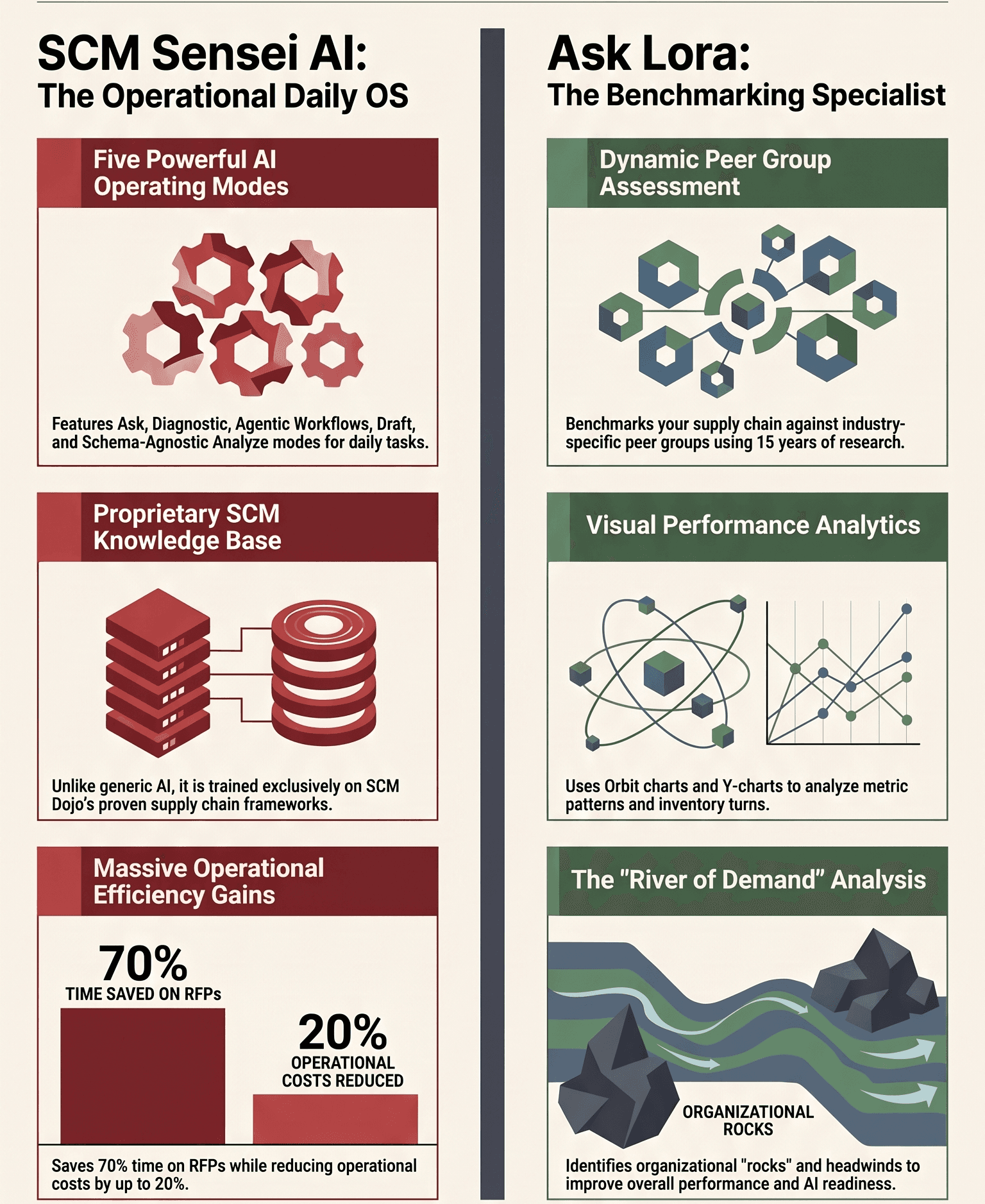
The infographic below illustrates the key structural differences between the two platforms at a glance. SCM SENSEI AI operates as a multi-mode operational system covering everything from expert advice to workflow execution. Ask Lora operates as a focused benchmarking engine with distinctive visual analytics outputs.
- Five operating modes covering daily supply chain tasks end-to-end
- Agentic workflows that execute multi-step processes automatically
- Schema-agnostic analysis of raw ERP and CSV data
- 28+ diagnostic types plus unlimited custom scenario assessment
- SOP and document generation through Draft mode
- Proprietary SCM knowledge base built on SCMDOJO's 15+ years of frameworks
- Dynamic peer-group benchmarking against 571+ companies
- Distinctive visual analytics: Y-charts, Orbit charts, River of Demand
- 15 years of longitudinal supply chain research data from Lora Cecere
- Secure, anonymised peer comparisons
- Board-ready reports in under 10 minutes
- Supply chain AI readiness assessment built into the flow
Who Gets the Most Value from Each Tool?
Supply chain AI tools are not one-size-fits-all. The question is not which tool is "better" in the abstract, but which tool delivers more value for your specific role, use case, and organisational context. Here is a practical breakdown.
Value by Role and Use Case
High value from both tools
SCM SENSEI AI for rapid client baselining (Diagnostic mode), workflow automation (Agentic Workflows), and SOP generation (Draft). Ask Lora for peer-group benchmarking that contextualises client performance against industry comparators. Many consultants will use both at different engagement phases.
Recommended: BothStrategic oversight and visibility
Ask Lora for peer benchmarking that supports board-level conversations and strategic positioning. SCM SENSEI AI for diagnostic assessment of organisational maturity and generating structured improvement roadmaps. The combination provides both the benchmark context and the actionable path forward.
Recommended: BothOperational execution
SCM SENSEI AI delivers the highest value for procurement teams. Agentic Workflows automate RFP sourcing, supplier evaluation, and procurement document generation. Draft mode generates SOPs and policy documents. Diagnostic mode provides procurement maturity assessment with prioritised improvement roadmap.
Primary: SCM SENSEI AIPlanning process improvement
Ask Lora's River of Demand analysis and S&OP capability assessment within its benchmarking framework are directly relevant. SCM SENSEI AI's S&OP Maturity Diagnostic provides a complementary structured assessment with gap analysis and prioritised actions.
Recommended: BothDaily execution support
SCM SENSEI AI's Ask mode provides daily expert supply chain advice. The Analyse mode processes logistics data from ERP exports without manual mapping. Diagnostic mode covers logistics excellence and warehouse operations assessment with specific gap analysis.
Primary: SCM SENSEI AIStrategic performance context
Ask Lora's board-ready benchmarking reports provide the executive-level peer comparison context for strategic investment decisions. SCM SENSEI AI's financial quantification of supply chain gaps supports the business case for supply chain transformation investments.
Primary: Ask LoraWhen to Use Each Tool
| Use Case | SCM SENSEI AI | Ask Lora |
|---|---|---|
| Run an RFP sourcing process | Primary choice | Not designed for this |
| Benchmark against industry peers | Not the primary use case | Primary choice |
| Generate an SOP or procurement document | Primary choice | Not designed for this |
| Assess supply chain maturity | 28+ diagnostic types, custom scenarios | Technology and S&OP focus |
| Analyse raw ERP or CSV data | Schema-agnostic Analyse mode | Not designed for this |
| Board-ready performance report | Roadmaps and gap analysis | Under 10 minutes |
| Daily supply chain expert advice | Ask mode, always available | Not the primary use case |
| Assess AI readiness | Digitalisation diagnostic | Built into assessment flow |
| Automate multi-step workflows | Agentic Workflows mode | Not designed for this |
| Identify S&OP performance barriers | S&OP Maturity Diagnostic | River of Demand analysis |
Pricing: What Each Tool Costs
- +Ask mode with limited queries
- +Basic diagnostic access
- +Explore the platform
- −Full agentic workflows
- −Unlimited diagnostics
- +All 5 modes: Ask, Diagnostic, Agentic Workflows, Draft, Analyse
- +28+ diagnostic types plus custom scenarios
- +Unlimited agentic workflow execution
- +Schema-agnostic ERP data analysis
- +Full SOP and document generation
- +250 chat questions per month
- +15 benchmarking reports per month
- +Personalised supply chain advice
- +Strategic insights from 40+ years of experience
- +Priority response times
SCM SENSEI AI is expanding its pricing model to increase accessibility. A $49/month Starter plan is coming soon for organisations and consultants who need core AI supply chain capabilities at a lower entry point. Additionally, a pay-as-you-go option powered by Stripe is in development, allowing customers to pay based on actual AI consumption rather than a flat monthly fee. This makes enterprise-grade supply chain AI accessible at any scale.
Frequently Asked Questions: Supply Chain AI Tools
What are the best supply chain AI tools in 2026?
What is SCM SENSEI AI and what can it do?
What is Ask Lora and how does it work?
How do supply chain AI tools differ from generic AI like ChatGPT or Claude?
Which supply chain AI tool is better for consultants?
What is the pricing for SCM SENSEI AI and Ask Lora?
Start Working With Supply Chain AI Tools Today
Both platforms offer entry points to get started immediately. SCM SENSEI AI has a free plan. Ask Lora has a $49 monthly subscription with no long-term commitment. The best way to understand which delivers more value for your specific context is to try both.

Dr. Muddassir Ahmed
Founder and CEO, SCMDOJO & Director, SCM SENSEI AI LtdDr. Muddassir Ahmed is a globally recognised supply chain expert, thought leader, and keynote speaker. As the Founder and CEO of SCMDOJO and Director of UK SENSEI AI Ltd, he has built two of the world's leading supply chain platforms: SCMDOJO for education and knowledge, and SCM SENSEI AI for AI-powered supply chain decision-making. With over 19 years of leadership experience spanning the UK, Europe, the Middle East, and Southeast Asia, Dr. Ahmed has held key roles at Bridgestone, Doncasters Group, Eaton, and Volvo Cars, managing multi-million-dollar supply chain operations.
Recognised among the Top 10 Supply Chain Influencers in the World by Supply Chain Digital. PhD in Management Science from Lancaster University Management School. Certified Six Sigma Black Belt. Serving 51,000+ monthly visitors on SCMDOJO, 72,000 newsletter subscribers, and 105,000+ social followers.